
Investors
The social network for art
Artema is a mobile app designed in France. Every member builds a personal museum, fed by three services: AI artwork recognition, an encyclopedia and a visit companion. Version 1.0 has been on the App Store since 7 November 2026.
The problem
At a museum, attention lasts less than a minute, and the memory barely longer
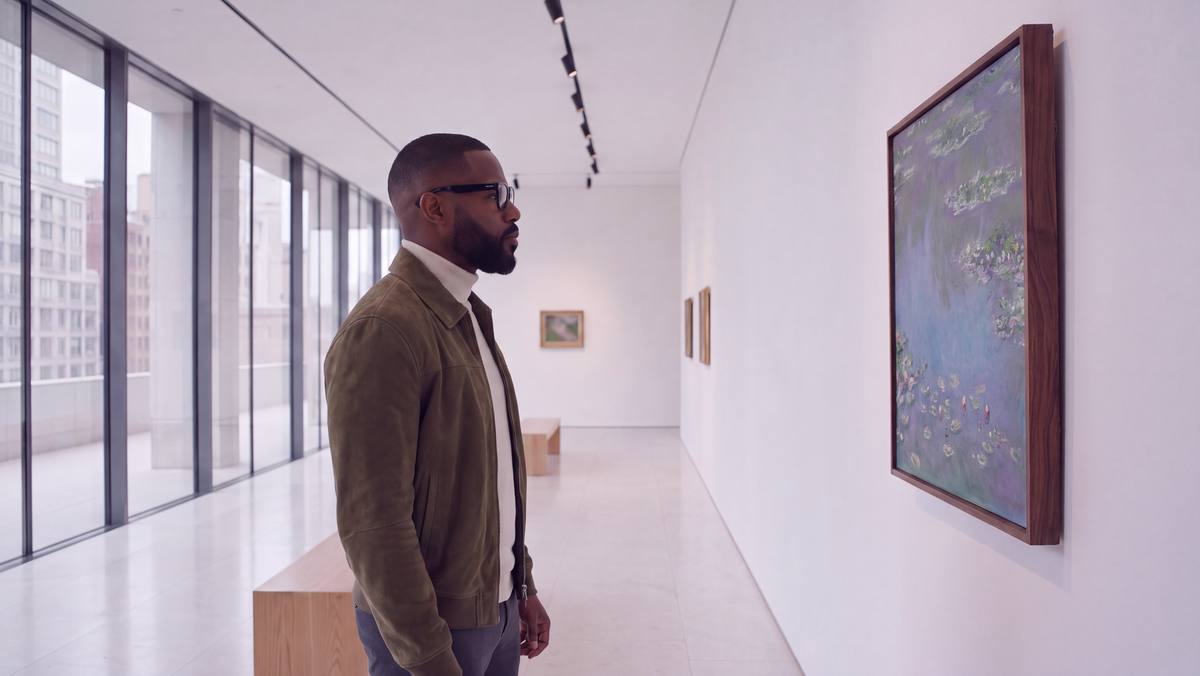
- A glance that is too short. Visitors spend 28.6 seconds on average in front of an artwork, including reading the label[3]. The label gives a title and a date, rarely a story, and often in a single language.
- Photos without context. More than one observed visitor in three takes a selfie with the artworks[3]. Those pictures end up in the camera roll, with no title, no artist, no place.
- Siloed tools. An audio guide covers a single museum. General social networks don’t know what they are showing: a painting is just one image among many.
The solution
One network, three services that feed it
Multimodal AI models can now recognise an artwork without a proprietary image database. Where existing solutions depend on the digitised collections of their partner venues, Artema works from day one, in any museum and in the visitor’s language.
Social network
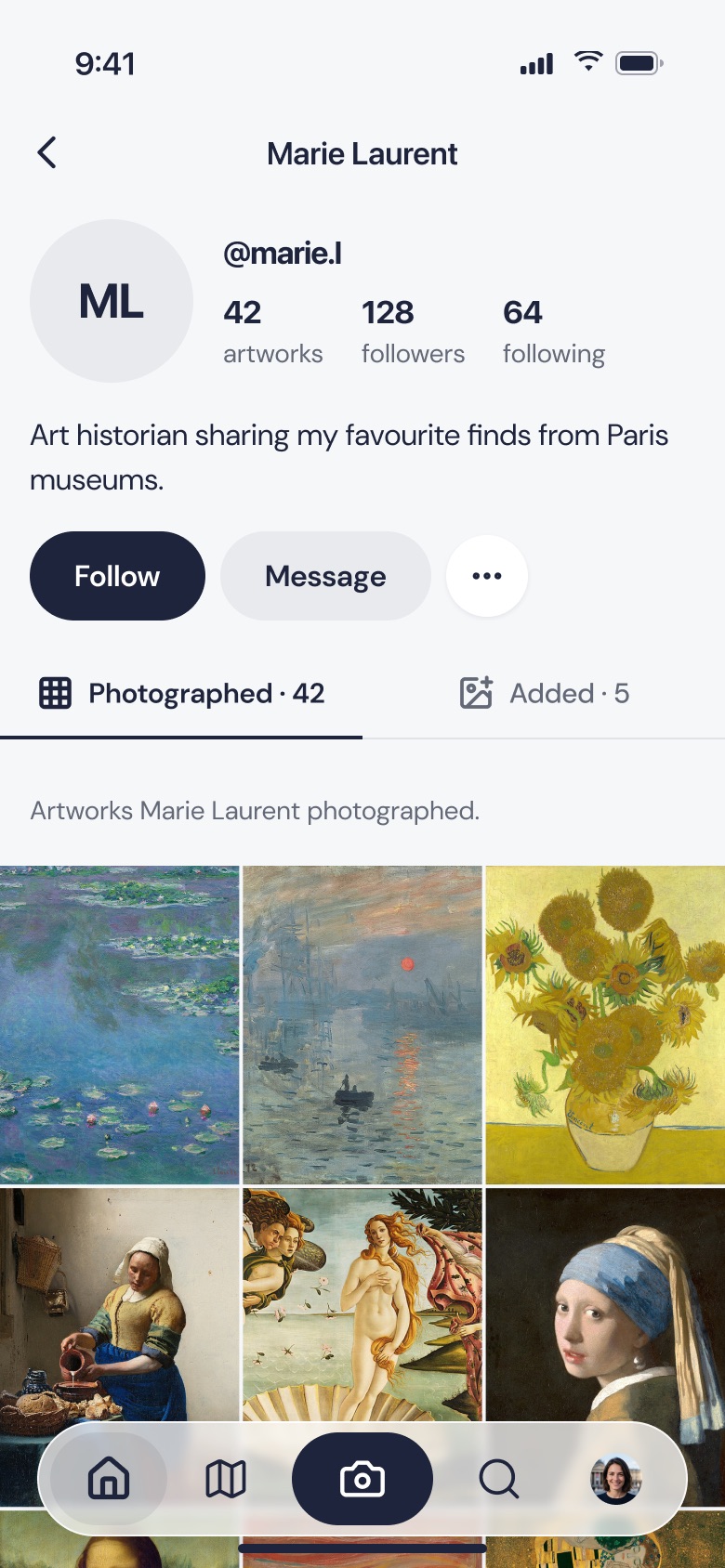
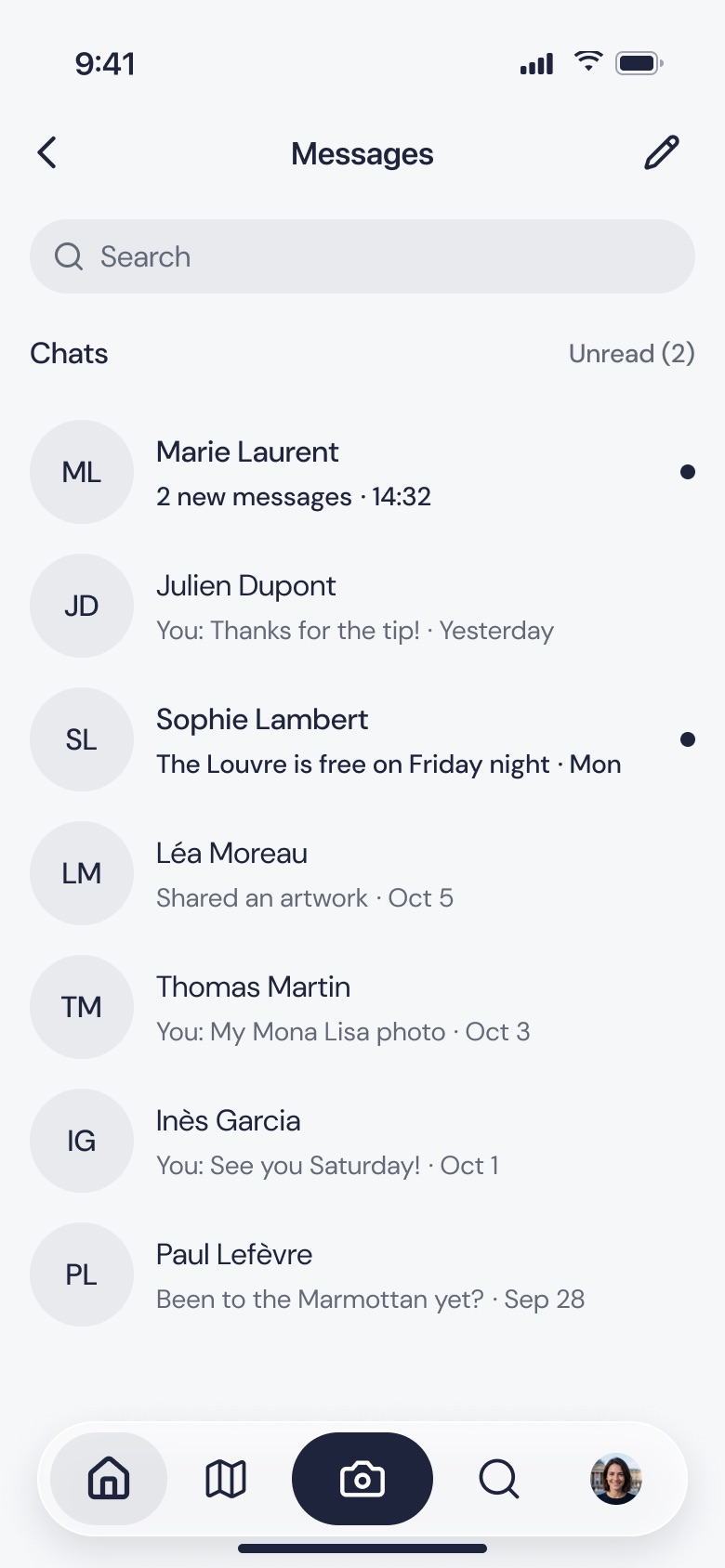
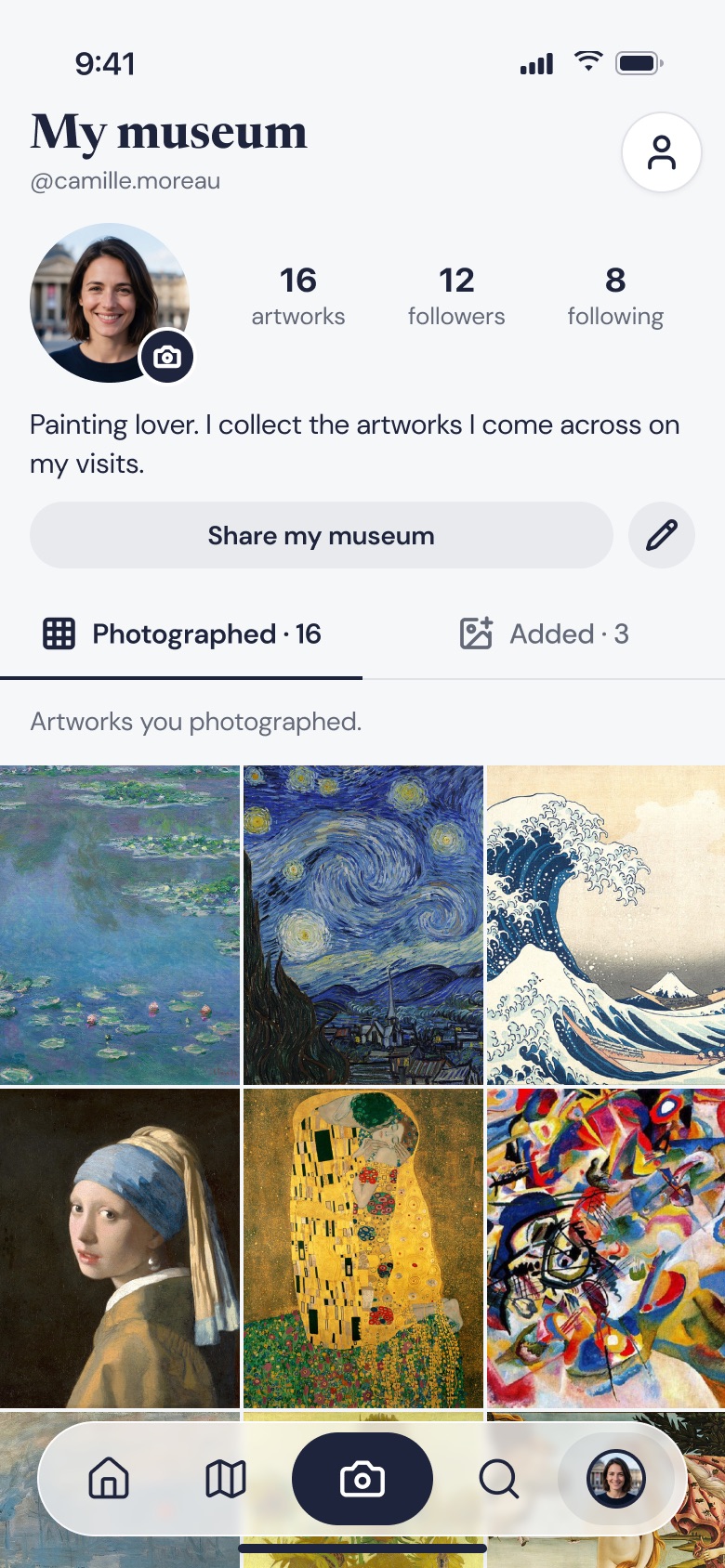
Every member shows a personal museum, public or private. The feed, follows and messages turn visits into conversations, and members enrich the encyclopedia: an unknown artwork, photographed with its label, becomes a page credited to them.
Recognition
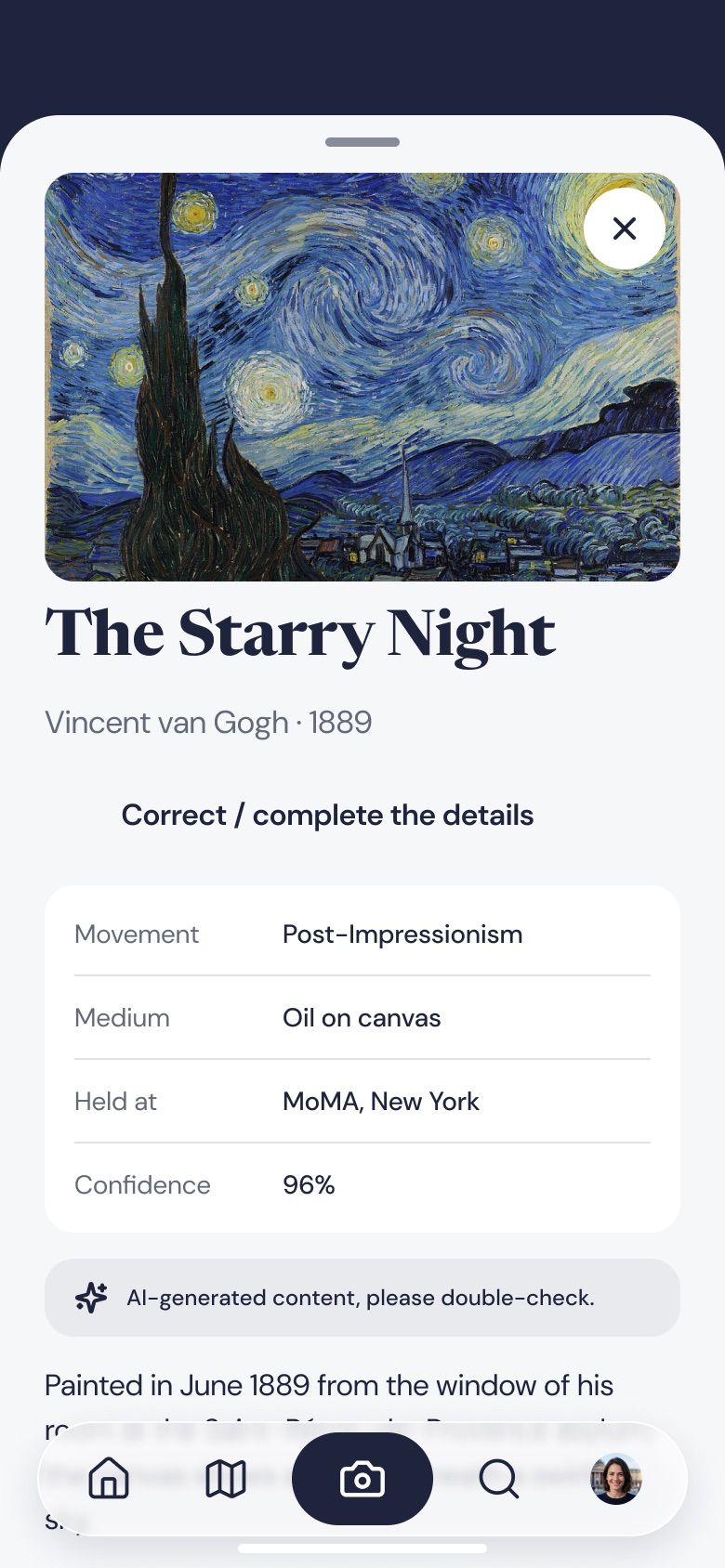
A state-of-the-art multimodal AI built for art recognises the work without a proprietary image database. It reads the label and runs a reverse web search for lesser-known works.
Encyclopedia
Pages on artworks, artists, movements and museums, and a search engine that writes a page for any name.
Visit companion
A worldwide directory of museums on a map, with their exhibitions and opening hours, and the answer to “where can I see the Mona Lisa?”.
The community
The social network, the engine of growth and retention
Your museum is your profile. A museum app is only used on the day of the visit; a social network turns it into a habit: recognition attracts, the encyclopedia and the visit bring people back, and the network retains them.
- A reason to come back. The feed, follows, notifications and messages bring members back between visits.
- Content that creates itself. Every scan can become a post linked to an artwork, an artist and a place: the more members visit, the richer the feed.
- Network effects. Each new member brings their discoveries to the others; public profiles, shares and content creators spread the word about Artema beyond its members.
- A qualified audience. The artworks, movements and museums the community cares about, measured in an aggregated and anonymous way, give museums and advertisers a precise audience, without individual tracking.
- A safe community. Reporting, blocking and moderation within 24 hours: a prerequisite for growing on the app stores and with institutions.
The product today
Version 1.0 is live
- Live. On the App Store since 7 November 2026, in English and French. Android in internal testing, on the same codebase (Expo, React Native), Supabase back end.
- Social network. A museum for every member, public or private; feed, likes, comments, reposts, follows, notifications and private messages.
- Contributions. An unknown artwork becomes a page credited to the member, from a photo of its label or a filled-in page (update 1.0.1, in testing).
- Recognition. Identification by a multimodal AI, reverse web search for lesser-known works, high-resolution reproductions from Wikimedia Commons.
- Encyclopedia. Pages on artworks, artists, movements and museums; a search engine that writes a page for any name.
- Visit companion. A worldwide museum directory built from Wikidata, a map of nearby museums, “where to see an artwork”, exhibitions, prices and opening hours read from official websites.
- Trust. Moderation (reporting, blocking, handled within 24 hours), anti-abuse quotas, GDPR compliance and accessibility by design.
- Foundations. A documented design system, Figma designs for every journey, the Artema trademark registered in France (INPI).
The first usage metrics (downloads, scans, retention) will be shared with the people registered on this page.
The market
A global market, an app that is already bilingual
Artema is for anyone who comes across art: regular museum-goers, cultural tourists, passers-by walking into a church or a gallery. It is launching in France for now, but the app already speaks English and French: the United Kingdom, North America and international visitors are the next step.
1.52 billion international tourists
in 2025, up 4%, more than half of them in Europe[1]. Major museums are must-see stops on their trips.
More than 200 million visits
to the world’s 100 most visited art museums in 2025, led by the Louvre with 9 million[2].
About 104,000 museums
worldwide, according to UNESCO[5]. AI identification needs no local partnership, and since pages are written by AI, they can be written in the member’s language: each new language mostly costs the translation of the interface.
France, the home market
72.7 million visits to France’s “Musées de France” in 2024[6] and 102 million international tourists in 2025, the world’s leading destination[7].
Business model
A hybrid model: subscription, advertising and partnerships
Free to download, then four revenue streams switched on as the audience grows: subscription from launch, affiliate revenue within the first months, advertising and the museum offer once the audience is established. Assumptions to be validated during the first year.
-
Subscription
Artema Plus
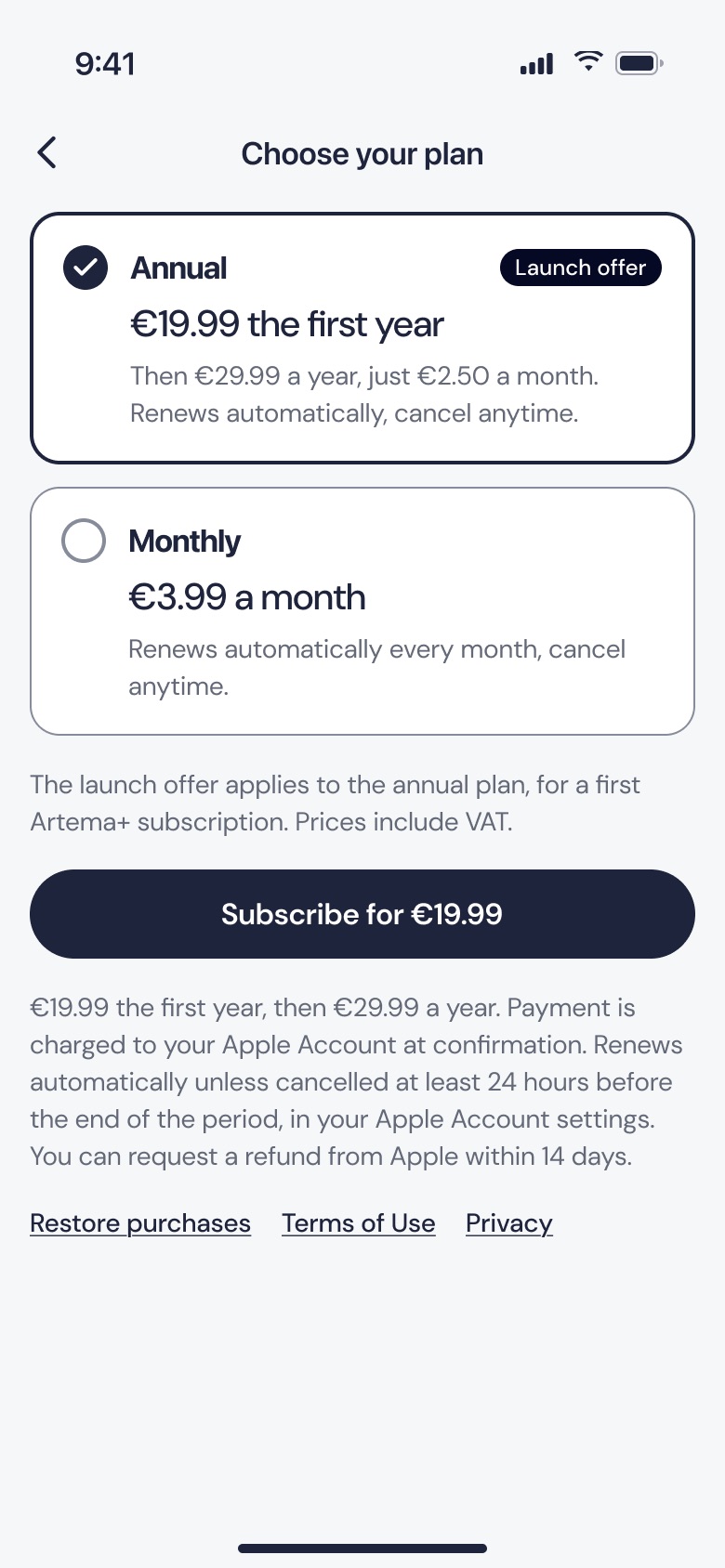
For enthusiasts: scans beyond the free daily quota, in-depth pages, visit routes, offline access.
€3.99 a month€29.99 a year€19.99 for the first year at launch

 Institutions
Museum offer
Verified official page, featured exhibitions, content from curatorial teams, aggregated and anonymous statistics on the most scanned artworks.
 Affiliate
Tickets, tours and prints
Booking tickets and guided tours from the museum page, posters and prints of public domain works from the artwork page, with a commission on each sale.
 Advertising
Native formats and sponsorship
Exhibitions, galleries, auction houses, art publishers and cultural tourism: ads built into the feed and pages, targeted by context (museum, city, movement, artist, language). A qualified, international audience that general social networks rarely offer.
Competition
Identification, knowledge, collection and community in one app
| Solution | Network made for art | Personal museum | Recognises an artwork | Tells its story | Visit guide |
|---|---|---|---|---|---|
| Artema | Yes | Yes, with the place | Anywhere | Yes | Worldwide map |
| Smartify | No | Yes | Works in its database | Yes | Partner venues |
| Google Lens | No | No | Anywhere | Web results | No |
| Audio guides | No | No | One museum | Yes | One museum |
| General | Posts | No | No | No |
How to read: a full dot means a complete feature, a half dot a partial feature, an empty circle a missing feature.
Smartify, backed by Metavallon VC and Pembroke VCT, reports more than 700 partner organisations[4]: the demand exists, and investors in the sector are following it.
Roadmap
An international launch, then new languages
Indicative timeline.
7 November 2026
DoneVersion 1.0 on the App Store
App in English and French, live on the App Store in France; website in English and French.
Winter 2026-2027
In progressAndroid and first members
Release on Google Play, content creator programme, press relations.
2027
First revenue
Artema Plus trial, ticketing affiliates, first partner museums and advertisers, in France and English-speaking countries.
Next
New languages
Spanish, Italian and German, following the major cultural tourism destinations.
Team
One founder, a team of agents
Artema is designed and built in France by Charles Peloye, sole founder, entrepreneur and product designer for 13 years.
More than 50 projects, from tech start-ups to major institutions: Doctolib, TotalEnergies, where he leads digital accessibility (RGAA), beta.gouv.fr, the Centre Pompidou-Metz, the Théâtre des Champs-Élysées. He also co-founded and chaired La Seigneurie du Néman.
To build Artema, he runs a team of AI agents (Claude Code) like a product team: app development and testing, builds and deployments, the design system and mock-ups, an automated beta tester on every release, market studies, film production. Charles sets the vision, makes every decision and signs off every delivery; the agents execute, check and document.
The result: a complete version 1.0, live on the App Store, with the cost structure of a one-person team. His full background is presented in the pitch, sent on request.
Investing in Artema
The pitch and the data, on request
Interested in the project, and perhaps in investing in it? Leave your details: you will receive Artema’s full presentation, then access to its data in the first weeks after launch.
Get the pitch
Sources
- UN Tourism, World Tourism Barometer, January 2026: 1.52 billion international tourist arrivals in 2025, including 793 million in Europe, reported by Hospitality Net. hospitalitynet.org
- The Art Newspaper, 2025 art museum attendance survey (published March 2026): more than 200 million visits to the top 100, led by the Louvre with 9,046,000 visitors, reported by ECO and Artforum. eco.sapo.pt · artforum.com
- L. F. Smith, J. K. Smith and P. P. L. Tinio, “Time spent viewing art and reading labels”, Psychology of Aesthetics, Creativity, and the Arts, 2017: 28.63 seconds on average, observed at the Art Institute of Chicago. doi.org/10.1037/aca0000049
- Tech.eu, “Museum app Smartify secures £1.5M funding”, 29 January 2025. tech.eu
- UNESCO, Museums around the world in the face of COVID-19, April 2021 (estimate of 104,000 museums), reported by The Art Newspaper, 13 April 2021. theartnewspaper.com
- French Ministry of Culture, Patrimostat 2026, reported by Localtis (Banque des Territoires), 17 September 2026 (in French). banquedesterritoires.fr
- Atout France, 2025 annual report: 102 million international tourists in 2025 (in French). atout-france.fr
This page presents the Artema project for information purposes only. It is neither a public offering of securities nor a solicitation to invest. Projections and timeline are indicative.